$20 million, divided by 162, comes out to $123,456.79.
I just thought you might want to know what the Red Sox paid for the privilege of watching Manny Ramirez sit during the most important game of the season.
(Bonus: throw in the Seattle game, and it's $246,913.58.)
In baseball world, that's actually not a very large amount of money as an absolute figure. But it is a number, and it's finally something that you can pin on Manny Ramirez. Sure, he's a terrible clubhouse presence and many of his teammates don't seem to like him, but it's hard to tell just how much, if at all, this detracts from the team's ability to win baseball games. Sure, his defense is terrible, but defensive liabilities are hard to put a number on, and they are surely outweighed by an .884 OPS and a .304 EqA. When Manny's being Manny, it's hard to put a concrete cost on it, and even if you could, that cost wouldn't even put a dent in his offensive production.
Last night (although it should be noted this isn't the first time Manny has sat out a game) changed all that. The gaudy stats weren't there; they were sitting on the bench while Coco Crisp and his .261 EqA took their place. And this time, there was a cost. A 1-0 loss, and $123,456.79. It's the 79 cents that really get to you.
Saturday, July 26, 2008

Monday, July 14, 2008
Yanked Around
This is what you get.
Last night's event in the Bronx was a game for the ages that by no means disappointed, but the buildup to it was bloated with false significance and overhype, colored by the interminable "End of Yankee Stadium" storyline. Those running "Great Moments in Yankee Stadium History" segments on SportsCenter are supposed to fill me with nostalgia, I suppose they do, but they also make me angry. SportsCenter may treat the demise of Yankee Stadium as inevitable, but it's not. It's being destroyed and replaced for basically no reason--a plan from a bygone era when the Yankees were strapped for cash. Now that they're the richest franchise in the world, there's no reason not to be content with the stadium they've got and the history that comes with it--but, of course, they're the Yankees, so they're not. When most of us are unhappy with the way things are going, we don't destroy one of the greatest living baseball cathedrals. I'm just saying, we restrain ourselves.
So, fine. The Yankees are destroying their history. They own it, I guess, so it's up to them. But I don't appreciate the hypocrisy of tearing down their past and then asking us to mourn its passing with them. New Yorkers have a tendency to assume that everyone loves New York as much as they do, but they may actually be right when it comes to Yankee Stadium, and it isn't right that they're taking it from us.
So, as an extension of the Yankee Stadium Destruction Neverending Nostalgia Tour, we got the hype surrounding the Last All-Star Game at Yankee Stadium, which was also misguided. Does it really matter if this is the last All-Star Game that Yankee Stadium ever hosts? Does anyone even remember what happened in the last All-Star Game that Yankee Stadium hosted? All-Star Games have given us some nice moments over the years, but in the end, they're just a fun midsummer spectacle. Why, in the last year of Yankee Stadium, have we suddenly decided that they are an integral part of the American cultural consciousness? For God's sake, just a few years ago we let it end in a tie. If the Steinbrenners suddenly decided to tear down the White House,* we wouldn't obsess over the fact that it was about to host its last Easter Egg Hunt on the lawn. We'd have more important memories to dwell on.
(A subplot to this subplot was the ridiculous"will Mariano Rivera start the All-Star Game???" debate. He was never going to, he shouldn't have, he didn't want to, no one really wanted him to, and no one really even wondered if he would until the media brought it up. This story was entirely media-created--I never heard any player or manager discuss it except in response to reporters' questions--except even the media thought it was a bad idea. Literally the entire story consisted of media members agreeing that their own idea was terrible. Great way to fill air time.)
All these elements combined to make the buildup to a perfectly ordinary All-Star Game feel like the buildup to Game 7 of the World Series. Of course, the All-Star Game did not end up being ordinary at all, but that was due entirely to J.D. Drew and Josh Hamilton, and not to Yankee Stadium. But that's the beauty of it. This should have been just another All-Star Game, but the Yankees and the media decided that it would be The All-Star Game to End All All-Star Games. And now that they've done that, the Yankees have to accept the fact that the MVP of the Yankee Stadium Sendoff and Weep-athon monstrosity was a player from Boston. That's what you get.
*This is by no means out of the question.
Last night's event in the Bronx was a game for the ages that by no means disappointed, but the buildup to it was bloated with false significance and overhype, colored by the interminable "End of Yankee Stadium" storyline. Those running "Great Moments in Yankee Stadium History" segments on SportsCenter are supposed to fill me with nostalgia, I suppose they do, but they also make me angry. SportsCenter may treat the demise of Yankee Stadium as inevitable, but it's not. It's being destroyed and replaced for basically no reason--a plan from a bygone era when the Yankees were strapped for cash. Now that they're the richest franchise in the world, there's no reason not to be content with the stadium they've got and the history that comes with it--but, of course, they're the Yankees, so they're not. When most of us are unhappy with the way things are going, we don't destroy one of the greatest living baseball cathedrals. I'm just saying, we restrain ourselves.
So, fine. The Yankees are destroying their history. They own it, I guess, so it's up to them. But I don't appreciate the hypocrisy of tearing down their past and then asking us to mourn its passing with them. New Yorkers have a tendency to assume that everyone loves New York as much as they do, but they may actually be right when it comes to Yankee Stadium, and it isn't right that they're taking it from us.
So, as an extension of the Yankee Stadium Destruction Neverending Nostalgia Tour, we got the hype surrounding the Last All-Star Game at Yankee Stadium, which was also misguided. Does it really matter if this is the last All-Star Game that Yankee Stadium ever hosts? Does anyone even remember what happened in the last All-Star Game that Yankee Stadium hosted? All-Star Games have given us some nice moments over the years, but in the end, they're just a fun midsummer spectacle. Why, in the last year of Yankee Stadium, have we suddenly decided that they are an integral part of the American cultural consciousness? For God's sake, just a few years ago we let it end in a tie. If the Steinbrenners suddenly decided to tear down the White House,* we wouldn't obsess over the fact that it was about to host its last Easter Egg Hunt on the lawn. We'd have more important memories to dwell on.
(A subplot to this subplot was the ridiculous"will Mariano Rivera start the All-Star Game???" debate. He was never going to, he shouldn't have, he didn't want to, no one really wanted him to, and no one really even wondered if he would until the media brought it up. This story was entirely media-created--I never heard any player or manager discuss it except in response to reporters' questions--except even the media thought it was a bad idea. Literally the entire story consisted of media members agreeing that their own idea was terrible. Great way to fill air time.)
All these elements combined to make the buildup to a perfectly ordinary All-Star Game feel like the buildup to Game 7 of the World Series. Of course, the All-Star Game did not end up being ordinary at all, but that was due entirely to J.D. Drew and Josh Hamilton, and not to Yankee Stadium. But that's the beauty of it. This should have been just another All-Star Game, but the Yankees and the media decided that it would be The All-Star Game to End All All-Star Games. And now that they've done that, the Yankees have to accept the fact that the MVP of the Yankee Stadium Sendoff and Weep-athon monstrosity was a player from Boston. That's what you get.
*This is by no means out of the question.
Sunday, July 6, 2008
An Open Letter To New York Yankees Fans
Hey guys,
How's it going? I caught that Darrell Rasner game the other day; that kid could be pretty decent in a few years. And hey, you guys got the All-Star Game this year. Pretty cool stuff.
Anyway, I'm writing to you today to make you an offer. I just purchased all seven games of the 2004 ALCS on DVD--not the highlights, but the complete games, every pitch, unedited, etc. But here's the thing--as much as I will enjoy watching games 4, 5, 6, and 7 over and over for the rest of my natural-born life, I don't really have any interest in games 1, 2, and 3--the ones that you guys won. Four years and a couple of championships have put those losses in perspective a little bit, but I still don't really have any desire to see them again--honestly, I don't see myself ever opening those particular discs.
And that's why I am presenting you with this unique, once-in-a-lifetime opportunity. For 3/7 of the price of the entire DVD set, you can now buy Games 1, 2, and 3 of the 2004 ALCS, unopened and in mint condition, and relive the three glorious Yankee victories from the 2004 league championship series! Better yet--through a small stretch of the imagination, you can pretend that the ALCS was actually a best-of-five series and ended after Game 3, making the Yankees the winners! Experience every thrilling moment as much-maligned Yankees star Alex Rodriguez finally gets that postseason monkey off his back! Watch as your favorite team vanquishes its greatest rival en route to another world championship, narrowly but successfuly avoiding a precipitous slide into a decade of mediocrity, overspending, and irrelevance!
This is your opportunity to change history, Yankee fans--I'll be waiting by the phone. And in the meantime, I hope for your guys' sake it turns out that Johnny Damon's injury isn't too bad.
How's it going? I caught that Darrell Rasner game the other day; that kid could be pretty decent in a few years. And hey, you guys got the All-Star Game this year. Pretty cool stuff.
Anyway, I'm writing to you today to make you an offer. I just purchased all seven games of the 2004 ALCS on DVD--not the highlights, but the complete games, every pitch, unedited, etc. But here's the thing--as much as I will enjoy watching games 4, 5, 6, and 7 over and over for the rest of my natural-born life, I don't really have any interest in games 1, 2, and 3--the ones that you guys won. Four years and a couple of championships have put those losses in perspective a little bit, but I still don't really have any desire to see them again--honestly, I don't see myself ever opening those particular discs.
And that's why I am presenting you with this unique, once-in-a-lifetime opportunity. For 3/7 of the price of the entire DVD set, you can now buy Games 1, 2, and 3 of the 2004 ALCS, unopened and in mint condition, and relive the three glorious Yankee victories from the 2004 league championship series! Better yet--through a small stretch of the imagination, you can pretend that the ALCS was actually a best-of-five series and ended after Game 3, making the Yankees the winners! Experience every thrilling moment as much-maligned Yankees star Alex Rodriguez finally gets that postseason monkey off his back! Watch as your favorite team vanquishes its greatest rival en route to another world championship, narrowly but successfuly avoiding a precipitous slide into a decade of mediocrity, overspending, and irrelevance!
This is your opportunity to change history, Yankee fans--I'll be waiting by the phone. And in the meantime, I hope for your guys' sake it turns out that Johnny Damon's injury isn't too bad.
Friday, July 4, 2008
Mustache Love
As it often does, Jason Giambi's fabulous 70's-era porn mustache has gotten me thinking. As a Red Sox fan, a baseball fan, and a human being, I hate Jason Giambi. As a Red Sox fan, I hate him because he's a Yankee. As a baseball fan, I hate him because he's the kind of big, slow, lumbering, three-run homer-hitting Moneyball-proving juggernaut that wins tons of baseball games but is almost no fun to watch. And as a human being, I hate him because he cheated. Jason Giambi used steroids (no normal human could grow that mustache), and even though some of the players I love probably did too, it's different when someone's either admitted it (as Giambi has) or been caught red-handed. Jason Giambi, I would argue, is more objectively hateable than most major-league baseball players.
A problem occurs when I try to apply the same formula to another objectively hateable player: one Manuel Aristides (!) Ramirez. As a baseball fan, it's hard to like Manny, who doesn't seem to try very hard when it comes to baserunning, fielding, or holding in his urine until the game is over. As a human being, it's hard to root for a guy who shoved his semielderly traveling secretary for no good reason. But what do you do, as a Red Sox fan, when such a loathsome character hits a home run to help your team win?
The answer, I think, is that you're allowed to root for a despicable player as part of a team, as long as you don't root for him as an individual. It's a nuanced distinction that can be especially tough to swallow because it allows you to perform certain actions for some reasons but not for others. For example, as a Red Sox fan, I can root for Manny Ramirez to do well, but only because it will help my team, and not because of a specific desire to see him do well. For most players, you end up rooting for both--I want to see the Red Sox do well, and I also want to see the Jon Lesters or Jacoby Ellsburys of the world do well because I like them/their style of play. For players like Manny, you have to separate the two--you have to turn rooting for Manny into rooting for the Red Sox.
This line of thinking ultimately brings me back to Jason Giambi and his Fabulous 70's-era Porn Mustache™. Because they have every right to want to see their team win, Yankees fans have every right to root for Jason Giambi to succeed. Same with Giants fans and Barry Bonds, Patriots fans and Rodney Harrison, etc. However, many Yankee fans have taken to wearing replica 'staches of their own to Yankee Stadium, and that seemingly insignificant gesture makes a world of difference. It can be difficult, as a fan, to navigate a sports world in which it sometimes seem that few athletes make good role models. But in trying to make sense of it all, there is one rule that seems relatively clear: you can root for the Yankees, but you can't root for the 'stache.
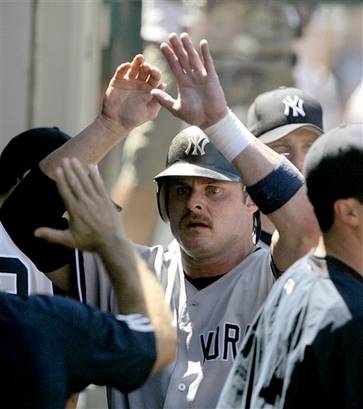
A problem occurs when I try to apply the same formula to another objectively hateable player: one Manuel Aristides (!) Ramirez. As a baseball fan, it's hard to like Manny, who doesn't seem to try very hard when it comes to baserunning, fielding, or holding in his urine until the game is over. As a human being, it's hard to root for a guy who shoved his semielderly traveling secretary for no good reason. But what do you do, as a Red Sox fan, when such a loathsome character hits a home run to help your team win?
The answer, I think, is that you're allowed to root for a despicable player as part of a team, as long as you don't root for him as an individual. It's a nuanced distinction that can be especially tough to swallow because it allows you to perform certain actions for some reasons but not for others. For example, as a Red Sox fan, I can root for Manny Ramirez to do well, but only because it will help my team, and not because of a specific desire to see him do well. For most players, you end up rooting for both--I want to see the Red Sox do well, and I also want to see the Jon Lesters or Jacoby Ellsburys of the world do well because I like them/their style of play. For players like Manny, you have to separate the two--you have to turn rooting for Manny into rooting for the Red Sox.
This line of thinking ultimately brings me back to Jason Giambi and his Fabulous 70's-era Porn Mustache™. Because they have every right to want to see their team win, Yankees fans have every right to root for Jason Giambi to succeed. Same with Giants fans and Barry Bonds, Patriots fans and Rodney Harrison, etc. However, many Yankee fans have taken to wearing replica 'staches of their own to Yankee Stadium, and that seemingly insignificant gesture makes a world of difference. It can be difficult, as a fan, to navigate a sports world in which it sometimes seem that few athletes make good role models. But in trying to make sense of it all, there is one rule that seems relatively clear: you can root for the Yankees, but you can't root for the 'stache.
Thursday, June 19, 2008
Anything's Possible
There's certainly a lot to talk about, in the wake of the Celtics' return to glory and Kobe Bryant's depantsing on national television. And soon, I may write something else on the series that completely changed the course of no fewer than seven NBA careers (Kevin Garnett, Ray Allen, Paul Pierce, Doc Rivers, Rajon Rondo, Kobe Bryant, Phil Jackson), and possibly an eighth (Lamar Odom).
But for now, let's focus on the moment that, for me, produced more lasting memories than any of the on-court action: Kevin Garnett's hilarious and poignant postgame interview with Michele Tafoya. There's already a breakdown out there, but just because Slate already did it doesn't mean they did it well. On we go:
0:00-0:10: Tafoya asks Garnett how adding "NBA champion" to his resume sounds. Garnett keeps his hands on his hat and his head down the entire time Tafoya is talking, and every few seconds he looks off to the side. It's possible he has no idea that Tafoya is there. It's possible that he has no idea that he is on a basketball court.
0:11-0:19: After Tafoya finishes, Garnett stares blankly at the floor for a full six seconds before beginning his answer with a heavy-sounding "Man, I...I'm so hyped right now." Normally one of the more intelligent and articulate athletes you'll find, Garnett is so dumbstruck by the moment that he is completely incapable of forming thoughts. Also of note is the fact that, at first, it sounds like he says "I'm so high right now," which, at the moment, would not appear to be all that far from the truth.
0:19-0:27: Garnett concludes his "answer" by muttering "anything's possible," before tilting his head back and repeating it as a primal battle cry that stretches for four complete seconds. It seems possible to view this as a funny moment, and in the context of a rather ridiculous interview, that's not entirely unreasonable. But given the long, mostly sad story of Garnett's career, and the rarity with which modern athletes show any real emotion, I submit to you that this was nothing less than the most moving moment of the entire Celtics season, and one of the all-time great emotional moments in sports. Garnett sways and almost collapses from the sheer effort of his emotional release.
0:28:-0:46: Garnett breaks down in tears, turning away from Tefoya. As Slate points out, this isn't one of those single tears that sometimes fall down athletes' cheeks at the thrill of victory, which is acceptable within the Code of Manhood to which all athletes religiously, sometimes overcompensatingly adhere. This is what would be, in any other context, a pathetic display: Garnett's voice is almost comically high-pitched and he is babbling uncontrollably. Slate views this display as less touching than normal athlete man-tears ("these are not the poignant tears of joy shed by Michael Jordan upon winning his first Larry O'Brien Trophy"), and maybe it is. But it is worth noting that the fact that he looks so helpless in front of millions of viewers means that Kevin Garnett has completely, 100% lost control over his emotions, and that is something that athletes rarely do in interviews. It makes him seem more human, somehow. Garnett points to the sky before being hugged extensively by some random Brian Scalabrine impersonator.
0:47-1:16 Garnett apologizes to an understanding Tafoya, and thanks a variety of people for his success, including his mother, before he seems to get stuck on the phrase "top of the world," which he yells twice directly into the camera.
1:17-1:39: Regrouping, Tefoya asks what "top of the world" feels like. In the actual funniest moment of the interview, Garnett suddenly, for the first time, seems to realize that he is in an interview. His automatic responses kick in, and he throws out the first interview cliche he can think of: praising the teammates. The result is a completely non-sequitorial "Ray Allen had a great game," which says very little about how "top of the world" feels. The moment probably reveals more than Garnett meant to about how athletes normally view these interviews--once he realizes he is being interviewed, out come the meaningless platitudes. Garnett ends this portion of the interview by stating that he is "certified."
1:40-1:42: "Michelle, you look good tonight, girl"--a different type of interview cliche, honed to perfection by Doc Rivers during these same playoffs. Normally it's vaguely sleazy, but here, Garnett's heart just isn't in it--he's just trying to get through the interview by searching desperately through his adrenaline-addled brain for what athletes usually say, just like "[Teammate X] had a great game."
1:43-2:22: To close out the interview, Garnett gives a relatively coherent and straightforward answer to a question about Celtic pride. A somewhat anticlimatic finish, but it comes on the heels of quite an entertaining show. Maybe it was funny, or maybe it was poignant (or both), but one thing is clear--no one cares about winning more than Kevin Garnett.
But for now, let's focus on the moment that, for me, produced more lasting memories than any of the on-court action: Kevin Garnett's hilarious and poignant postgame interview with Michele Tafoya. There's already a breakdown out there, but just because Slate already did it doesn't mean they did it well. On we go:
0:00-0:10: Tafoya asks Garnett how adding "NBA champion" to his resume sounds. Garnett keeps his hands on his hat and his head down the entire time Tafoya is talking, and every few seconds he looks off to the side. It's possible he has no idea that Tafoya is there. It's possible that he has no idea that he is on a basketball court.
0:11-0:19: After Tafoya finishes, Garnett stares blankly at the floor for a full six seconds before beginning his answer with a heavy-sounding "Man, I...I'm so hyped right now." Normally one of the more intelligent and articulate athletes you'll find, Garnett is so dumbstruck by the moment that he is completely incapable of forming thoughts. Also of note is the fact that, at first, it sounds like he says "I'm so high right now," which, at the moment, would not appear to be all that far from the truth.
0:19-0:27: Garnett concludes his "answer" by muttering "anything's possible," before tilting his head back and repeating it as a primal battle cry that stretches for four complete seconds. It seems possible to view this as a funny moment, and in the context of a rather ridiculous interview, that's not entirely unreasonable. But given the long, mostly sad story of Garnett's career, and the rarity with which modern athletes show any real emotion, I submit to you that this was nothing less than the most moving moment of the entire Celtics season, and one of the all-time great emotional moments in sports. Garnett sways and almost collapses from the sheer effort of his emotional release.
0:28:-0:46: Garnett breaks down in tears, turning away from Tefoya. As Slate points out, this isn't one of those single tears that sometimes fall down athletes' cheeks at the thrill of victory, which is acceptable within the Code of Manhood to which all athletes religiously, sometimes overcompensatingly adhere. This is what would be, in any other context, a pathetic display: Garnett's voice is almost comically high-pitched and he is babbling uncontrollably. Slate views this display as less touching than normal athlete man-tears ("these are not the poignant tears of joy shed by Michael Jordan upon winning his first Larry O'Brien Trophy"), and maybe it is. But it is worth noting that the fact that he looks so helpless in front of millions of viewers means that Kevin Garnett has completely, 100% lost control over his emotions, and that is something that athletes rarely do in interviews. It makes him seem more human, somehow. Garnett points to the sky before being hugged extensively by some random Brian Scalabrine impersonator.
0:47-1:16 Garnett apologizes to an understanding Tafoya, and thanks a variety of people for his success, including his mother, before he seems to get stuck on the phrase "top of the world," which he yells twice directly into the camera.
1:17-1:39: Regrouping, Tefoya asks what "top of the world" feels like. In the actual funniest moment of the interview, Garnett suddenly, for the first time, seems to realize that he is in an interview. His automatic responses kick in, and he throws out the first interview cliche he can think of: praising the teammates. The result is a completely non-sequitorial "Ray Allen had a great game," which says very little about how "top of the world" feels. The moment probably reveals more than Garnett meant to about how athletes normally view these interviews--once he realizes he is being interviewed, out come the meaningless platitudes. Garnett ends this portion of the interview by stating that he is "certified."
1:40-1:42: "Michelle, you look good tonight, girl"--a different type of interview cliche, honed to perfection by Doc Rivers during these same playoffs. Normally it's vaguely sleazy, but here, Garnett's heart just isn't in it--he's just trying to get through the interview by searching desperately through his adrenaline-addled brain for what athletes usually say, just like "[Teammate X] had a great game."
1:43-2:22: To close out the interview, Garnett gives a relatively coherent and straightforward answer to a question about Celtic pride. A somewhat anticlimatic finish, but it comes on the heels of quite an entertaining show. Maybe it was funny, or maybe it was poignant (or both), but one thing is clear--no one cares about winning more than Kevin Garnett.
Thursday, June 12, 2008
Whistle Blowers
Is the NBA fixed?
How about a better question: does it even matter?
Whether or not the NBA is rigged has been the subject of a great deal of debate, amplified by Tom Donaghy's self-serving allegation that the Kings deserved to beat the Lakers in 2002. On Sportscenter at this very moment, they are questioning whether Donaghy is a legitimate whistle-blower, or is simply tossing out the idea of a conspiracy in order to serve his own ends.
Sure, I'd like to know the answer to these questions. It is undoubtedly important for us to know whether it's simply bad officiating, refs acting on their own (for gambling purposes etc.), or a concerted effort from the NBA to affect the outcome of its playoffs. I would certainly be interested in hooking Donaghy and David Stern up to a polygraph. But
Let's assume, in an extremely magnanimous gift to David Stern, that it is just bad officiating. At the very least that's what it is (it seems that no one who saw that Kings-Lakers game could believe otherwise), but let's start there, in the least troubling of the three scenarios. This bad officiating, if that's what it was, was seriously terrible officiating. Ralph Nader wrote in to complain. The Lakers were on pace to shoot over 100 free throws a game at the rate fouls were being called. It's not an exaggeration to state that this may have been the worst-called game in American sports history.
And that's why it doesn't really matter if what Donaghy says is true. If, at best, the NBA has the worst officiating in history, then the league is already in crisis mode. Finding out that it was all part of a massive conspiracy would certainly hurt, but most of the damage is already done. There's little point in examining the worst-case scenario when even the best-case scenario necessitates massive changes. Regardless of what Donaghy says, the NBA has to be fixed. So it kind of matters if he's telling the truth, but not really.
How about a better question: does it even matter?
Whether or not the NBA is rigged has been the subject of a great deal of debate, amplified by Tom Donaghy's self-serving allegation that the Kings deserved to beat the Lakers in 2002. On Sportscenter at this very moment, they are questioning whether Donaghy is a legitimate whistle-blower, or is simply tossing out the idea of a conspiracy in order to serve his own ends.
Sure, I'd like to know the answer to these questions. It is undoubtedly important for us to know whether it's simply bad officiating, refs acting on their own (for gambling purposes etc.), or a concerted effort from the NBA to affect the outcome of its playoffs. I would certainly be interested in hooking Donaghy and David Stern up to a polygraph. But
Let's assume, in an extremely magnanimous gift to David Stern, that it is just bad officiating. At the very least that's what it is (it seems that no one who saw that Kings-Lakers game could believe otherwise), but let's start there, in the least troubling of the three scenarios. This bad officiating, if that's what it was, was seriously terrible officiating. Ralph Nader wrote in to complain. The Lakers were on pace to shoot over 100 free throws a game at the rate fouls were being called. It's not an exaggeration to state that this may have been the worst-called game in American sports history.
And that's why it doesn't really matter if what Donaghy says is true. If, at best, the NBA has the worst officiating in history, then the league is already in crisis mode. Finding out that it was all part of a massive conspiracy would certainly hurt, but most of the damage is already done. There's little point in examining the worst-case scenario when even the best-case scenario necessitates massive changes. Regardless of what Donaghy says, the NBA has to be fixed. So it kind of matters if he's telling the truth, but not really.
Sunday, June 8, 2008
Spirited Away
In high school, I worked at a summer camp-type locale called Summerbridge, where every day, one of the sixth- and seventh-grade attendees would receive an award. This award, called the Spirit Stick, went to a student who demonstrated exceptional program spirit and displayed a generally positive and constructive attitude.
Believe it or not, this meaningless summer camp award has a lot to do with Kobe Bryant. You see, at a meeting at the end of every day, the Summerbridge staff would determine who would win the Spirit Stick the next day, and it was often a highly contentious process. Frequently, one of the teachers would decide to nominate one of the program's worst discipline problems because they'd had, for them, a relatively good day, in that they didn't hit any of the other students. Sometimes, students who had made a legitimate case to win the award, through genuine friendliness and good deeds, would lose out to a student who had done absolutely nothing, and who had simply refrained from misbehaving for a day.
That student who won the award so undeservingly is the sixth-grade summer camp version of Kobe Bryant. Kobe used to be, in short, a discipline problem. He called out his teammates and threw them under the bus. He inspired his coach to write a book about how much he hated his star player. He might have raped somebody. While his incredible skills made him the kind of guy you'd want on your team, he was not the kind of guy you'd want on your team.
Then Kobe changed. He curtailed his petulant behavior and stopped giving the media bratty quotes and trade demands. He started passing the ball to his teammates. He continued to cheat on his wife, but at least stopped committing borderline sexual assault. He was not a model citizen any more than Derek Fisher was (actually, much less than Derek Fisher was). But at least he'd stopped hitting his classmates.
This would all be well and good, except we've given Kobe the Spirit Stick for it. Of course, there's no actual award for being a great teammate, but there is no shortage of media stories on Kobe's rebirth. And that's fine in theory, since he has been reborn--I'm just sick of reading articles fawning over the fact that Kobe now sometimes passes to teammates rather than taking all the shots himself. Not ball-hogging, the absence of a basketball crime, has become praiseworthy in its own right. We might as well credit him for every defensive set in which he doesn't commit a foul, or every postgame press conference in which he doesn't insult Sasha Vujacic.
Personally, I find Kobe Bryant to be one of the more hateable athletes out there, but I suppose I can see how someone could legitimately disagree. What I can't comprehend is why we seem so intent on praising him. His talent is as elite as it has always been, but as a team leader, he's finally (and maybe not even permanently) risen to somewhere in the neighborhood of average. And for that, I refuse to give him a Spirit Stick.
Believe it or not, this meaningless summer camp award has a lot to do with Kobe Bryant. You see, at a meeting at the end of every day, the Summerbridge staff would determine who would win the Spirit Stick the next day, and it was often a highly contentious process. Frequently, one of the teachers would decide to nominate one of the program's worst discipline problems because they'd had, for them, a relatively good day, in that they didn't hit any of the other students. Sometimes, students who had made a legitimate case to win the award, through genuine friendliness and good deeds, would lose out to a student who had done absolutely nothing, and who had simply refrained from misbehaving for a day.
That student who won the award so undeservingly is the sixth-grade summer camp version of Kobe Bryant. Kobe used to be, in short, a discipline problem. He called out his teammates and threw them under the bus. He inspired his coach to write a book about how much he hated his star player. He might have raped somebody. While his incredible skills made him the kind of guy you'd want on your team, he was not the kind of guy you'd want on your team.
Then Kobe changed. He curtailed his petulant behavior and stopped giving the media bratty quotes and trade demands. He started passing the ball to his teammates. He continued to cheat on his wife, but at least stopped committing borderline sexual assault. He was not a model citizen any more than Derek Fisher was (actually, much less than Derek Fisher was). But at least he'd stopped hitting his classmates.
This would all be well and good, except we've given Kobe the Spirit Stick for it. Of course, there's no actual award for being a great teammate, but there is no shortage of media stories on Kobe's rebirth. And that's fine in theory, since he has been reborn--I'm just sick of reading articles fawning over the fact that Kobe now sometimes passes to teammates rather than taking all the shots himself. Not ball-hogging, the absence of a basketball crime, has become praiseworthy in its own right. We might as well credit him for every defensive set in which he doesn't commit a foul, or every postgame press conference in which he doesn't insult Sasha Vujacic.
Personally, I find Kobe Bryant to be one of the more hateable athletes out there, but I suppose I can see how someone could legitimately disagree. What I can't comprehend is why we seem so intent on praising him. His talent is as elite as it has always been, but as a team leader, he's finally (and maybe not even permanently) risen to somewhere in the neighborhood of average. And for that, I refuse to give him a Spirit Stick.
Wednesday, June 4, 2008
Save Tonight
First of all, if you're wondering what the title of this post has to do with Barry Bonds (the subject of said post), it's because I figured I should make a pun on the word "bonds," thought of Max Cherry, the bail bondsman character in Jackie Brown, and that led me to 90's one-hit wonder Eagle Eye Cherry. You are already regretting that you asked.
But anyway: on to Mr. Bonds. A recent blog post on boston.com suggested that, with David Ortiz on the DL for a semi-extended period of time, the Red Sox have to at least consider signing the most employable unemployable man in baseball. Sure, he's perhaps the most hated athlete in American history, but he is undoubtedly beneficial to any team, and especially in the American League, where he can DH and never has to move his extremely brittle body.
A lot of Sox fans are coming out in support of such a plan, but in my opinion, they're conflating the role of the team ownership with the role of the fan. Sure, it makes sense from the ownership's point of view. The team owners have one of two goals, depending on how cynical you are: make money or make wins (which, conveniently, make money). Barry accomplishes both of these goals--it's hard to argue he'd OPS less than Ortiz's replacement (Brandon Moss??!??!?!?!?!?!??!@1), and the controversy should be good for a few dollars. Some moralizing fans might be outraged and relinquish their season tickets, but there are always enough fans in Boston to take their place, so it's hard to see how signing a public-image nightmare could realistically cost the team money.
But, in my opinion, the fan has different goals from the team owner. The fan, when you really think about it, doesn't want their team to be as good as possible. They want their team to be as fun to root for as possible. This point often goes overlooked because the two go so reliably hand-in-hand: winning teams are more fun to watch and cheer for, which is why I'm happy I'm a Red Sox fan and not a Yankees fan. But they don't always go together, and the "Don't sign A-Rod!" chant is proof of that. Sure we want our teams to win, but first things first: we want a team that we like, and then we want that team to do as well as possible.
So, maybe that boston.com is right: maybe the Red Sox should consider signing Bonds. It's certainly in the management's best interests. But as fans, we don't have to buy into that. We don't like Barry, and for most of us, I think that's more important than winning a few more games.
But anyway: on to Mr. Bonds. A recent blog post on boston.com suggested that, with David Ortiz on the DL for a semi-extended period of time, the Red Sox have to at least consider signing the most employable unemployable man in baseball. Sure, he's perhaps the most hated athlete in American history, but he is undoubtedly beneficial to any team, and especially in the American League, where he can DH and never has to move his extremely brittle body.
A lot of Sox fans are coming out in support of such a plan, but in my opinion, they're conflating the role of the team ownership with the role of the fan. Sure, it makes sense from the ownership's point of view. The team owners have one of two goals, depending on how cynical you are: make money or make wins (which, conveniently, make money). Barry accomplishes both of these goals--it's hard to argue he'd OPS less than Ortiz's replacement (Brandon Moss??!??!?!?!?!?!??!@1), and the controversy should be good for a few dollars. Some moralizing fans might be outraged and relinquish their season tickets, but there are always enough fans in Boston to take their place, so it's hard to see how signing a public-image nightmare could realistically cost the team money.
But, in my opinion, the fan has different goals from the team owner. The fan, when you really think about it, doesn't want their team to be as good as possible. They want their team to be as fun to root for as possible. This point often goes overlooked because the two go so reliably hand-in-hand: winning teams are more fun to watch and cheer for, which is why I'm happy I'm a Red Sox fan and not a Yankees fan. But they don't always go together, and the "Don't sign A-Rod!" chant is proof of that. Sure we want our teams to win, but first things first: we want a team that we like, and then we want that team to do as well as possible.
So, maybe that boston.com is right: maybe the Red Sox should consider signing Bonds. It's certainly in the management's best interests. But as fans, we don't have to buy into that. We don't like Barry, and for most of us, I think that's more important than winning a few more games.
Thursday, May 29, 2008
Does Not Compute
Far be it from me to criticize Fire Joe Morgan, quite possibly the best web site out there on the subject of firing Joe Morgan. But I do have to take slight exception with one of their arguments in a recent post about instant replay. The FJM guys are in favor of the introduction of instant replay in baseball, which is good, because the people opposing it tend to rely on the same flimsy "preserve the sanctity of the game, you can't change the way it's always been" arguments that could just as easily have been used to oppose, say, having black people on your team. And since Ken Griffey Jr. is my all-time favorite player, I tend not to like those arguments.
So, Mose Schrute & Co. seem to be on the right side of things, except a little farther down in their post, they say this:
"If this plan were to take QuesTec and create a LASERTechnoGrid™ on every batter and put a chip in the ball and have the LASERTechnoGrid™ turn red for strikes and green for balls, then yes, I would say, that's silly, and let's let humans be humans. But huge game-altering HR calls? That can be corrected with like a minute's review of normal TV camera work? Why not do that?"
See, right now, instant reply is being proposed only for use in home run calls, and FJM is in favor of that. But when it comes to balls and strikes and other more mundane determinations, they come down in favor of human umpires. And while I could spend years arguing against people who are against replay altogether, it seems more fun to take on this more nuanced position.
At the risk of offending the all-powerful Umpires Union of America (not to mention the guys at FJM, who I probably respect much more than I should considering I have never and will never meet them), I don't see why we can't computerize whatever the hell we want. Sure, a blown home run call is much more likely to affect the course of a season than a blown strike call, but why risk blowing any calls now that a computer can just tell us what's a strike and what's not? Robotic umpires may seem scary, but I think we have to get over that. Shoeless Joe Jackson said he didn't like the stadium lights in Field of Dreams, but we installed the damn things anyway, so we could have Red Sox-Yankees games that go until 1 AM and slowly drive us insane. The system works.
Is it that we don't want certainty? Do we not want to pin the strike zone down? The strike zone is famously fickle, expanding for marquee pitchers, no-hitters, etc. I can see the legitimacy in the argument that we're better off keeping that rather charming element of baseball. But I disagree with that--I don't want to gawk at a pitcher's stats or enjoy a no-hitter unless I know for sure all the calls are legit. Sometimes, when I watch the replay of the last out of Clay Buchholz's no-hitter, I think that curveball might just have been half an inch off the plate. If I knew for sure, I'd be able to celebrate in peace. And if the last game of the World Series did come down to a questionable strike call, I think the last thing I'd want to do is let humans be humans.
So, Mose Schrute & Co. seem to be on the right side of things, except a little farther down in their post, they say this:
"If this plan were to take QuesTec and create a LASERTechnoGrid™ on every batter and put a chip in the ball and have the LASERTechnoGrid™ turn red for strikes and green for balls, then yes, I would say, that's silly, and let's let humans be humans. But huge game-altering HR calls? That can be corrected with like a minute's review of normal TV camera work? Why not do that?"
See, right now, instant reply is being proposed only for use in home run calls, and FJM is in favor of that. But when it comes to balls and strikes and other more mundane determinations, they come down in favor of human umpires. And while I could spend years arguing against people who are against replay altogether, it seems more fun to take on this more nuanced position.
At the risk of offending the all-powerful Umpires Union of America (not to mention the guys at FJM, who I probably respect much more than I should considering I have never and will never meet them), I don't see why we can't computerize whatever the hell we want. Sure, a blown home run call is much more likely to affect the course of a season than a blown strike call, but why risk blowing any calls now that a computer can just tell us what's a strike and what's not? Robotic umpires may seem scary, but I think we have to get over that. Shoeless Joe Jackson said he didn't like the stadium lights in Field of Dreams, but we installed the damn things anyway, so we could have Red Sox-Yankees games that go until 1 AM and slowly drive us insane. The system works.
Is it that we don't want certainty? Do we not want to pin the strike zone down? The strike zone is famously fickle, expanding for marquee pitchers, no-hitters, etc. I can see the legitimacy in the argument that we're better off keeping that rather charming element of baseball. But I disagree with that--I don't want to gawk at a pitcher's stats or enjoy a no-hitter unless I know for sure all the calls are legit. Sometimes, when I watch the replay of the last out of Clay Buchholz's no-hitter, I think that curveball might just have been half an inch off the plate. If I knew for sure, I'd be able to celebrate in peace. And if the last game of the World Series did come down to a questionable strike call, I think the last thing I'd want to do is let humans be humans.
What's Up, Doc?
I've been thinking a lot lately about the 2007 New England Patriots. The Pats were heavy Super Bowl favorites, but they had also just come off of a particularly trying and exhausting undefeated regular season. The NFL playoffs, of course, are always win (every game)-or-go-home no matter what you did during the season, but that's a harder mentality to deal with when you've already been playing under that burden for 17 weeks, and eventually, the Patriots just couldn't take it anymore. The end of a grueling season came one game too late.
We all remember what happened in the Super Bowl, but the signs were there in all the other playoff games, and even a few regular-season games. The Patriots were one of the best teams ever assembled, but they began to buckle under the weight of their expectations. One of the most dominant teams of all time was forced to hold off the likes of the Philadelphia Eagles and the Baltimore Ravens, not exactly top-tier teams, with little more than smoke and mirrors. In those games, and in playoff games against Jacksonville and San Diego, the Patriots still won, but every down felt like a strain. They strayed from the game plan that made them successful in the first place, opening their games by passing on every down as though they were down by 10 in the fourth quarter. Despite always being the superior team, they played as though they were desperate underdogs.
So why am I talking about the 2007 Patriots in May of 2008, especially when I underwent months of intensive electro-shock therapy to cleanse all thoughts of the 2007 NFL playoffs from my mind? Because the Celtics are starting to cause me similar heart palpitations. They're definitely the best team in the East, perhaps the best team in the NBA, and all of a sudden they're the team that has to pull out all the stops to dispatch the Atlanta Hawks. Now that they're in the playoffs, they've strayed from the game plan that got them there. As many have already pointed out, they didn't exactly play like champions in the fourth quarter last night, and any win where their opponent scores in triple digits is not the way the Celtics want to win. Their defense suddenly appears porous, while their offense at times becomes the basketball equivalent of passing on every down.
So yes, there are similarities between the Boston Celtics and the New England Patriots of this past year, but there is also one important difference: the Patriots had an excuse. To me, the 2007 season was proof that no team will ever go 19-0 (and especially not 20-0, if that 17th game ever does get added to the regular season). My personal opinion, after watching every down of that Bataan death march to the Super Bowl, is that the pressure of going undefeated is too much for any team to take now that the schedule runs 19 games. Given that, it's hard to blame the Patriots' coaching for their psychological collapse. Bill Belichick, controversies aside, is an undeniably brilliant coach, and if his team couldn't make it, I'm willing to believe no one could. It's not his fault.
The Celtics, however, have no such excuses. Sure, there's pressure on their heads--two newcomers and Paul Pierce have basically been charged with the task of triplehandedly restoring Boston's love for basketball, and that's no easy job. But it's no undefeated season either--we're just asking them to win, not win every time. One team does it every year, and it's certainly doable for the Celtics this year. And yet, they seem to be caving in to pressure much in the same way that the Patriots did, even though they face much less of it.
And that's what it boils down to: Doc Rivers is no Bill Belichick, and probably isn't even a Pete Carroll. His team has more talent on paper than any other team in the East, so theoretically a Yorkshire Terrier should be able to serve as coach and just watch the team win from the sidelines (and it would get to wear a little suit, which would be adorable). No one's asking Doc to be a miracle-worker; his only job is to make sure that his team plays up to its potential. And when all the series go to seven games and the Celtics have just one win on the road, it starts to seem as though all the intangibles that Doc is supposed to deal with are really dragging this team down. It makes you wonder what this team could do with basketball's version of Bill Belichick at the helm. Or even Pete Carroll.
We all remember what happened in the Super Bowl, but the signs were there in all the other playoff games, and even a few regular-season games. The Patriots were one of the best teams ever assembled, but they began to buckle under the weight of their expectations. One of the most dominant teams of all time was forced to hold off the likes of the Philadelphia Eagles and the Baltimore Ravens, not exactly top-tier teams, with little more than smoke and mirrors. In those games, and in playoff games against Jacksonville and San Diego, the Patriots still won, but every down felt like a strain. They strayed from the game plan that made them successful in the first place, opening their games by passing on every down as though they were down by 10 in the fourth quarter. Despite always being the superior team, they played as though they were desperate underdogs.
So why am I talking about the 2007 Patriots in May of 2008, especially when I underwent months of intensive electro-shock therapy to cleanse all thoughts of the 2007 NFL playoffs from my mind? Because the Celtics are starting to cause me similar heart palpitations. They're definitely the best team in the East, perhaps the best team in the NBA, and all of a sudden they're the team that has to pull out all the stops to dispatch the Atlanta Hawks. Now that they're in the playoffs, they've strayed from the game plan that got them there. As many have already pointed out, they didn't exactly play like champions in the fourth quarter last night, and any win where their opponent scores in triple digits is not the way the Celtics want to win. Their defense suddenly appears porous, while their offense at times becomes the basketball equivalent of passing on every down.
So yes, there are similarities between the Boston Celtics and the New England Patriots of this past year, but there is also one important difference: the Patriots had an excuse. To me, the 2007 season was proof that no team will ever go 19-0 (and especially not 20-0, if that 17th game ever does get added to the regular season). My personal opinion, after watching every down of that Bataan death march to the Super Bowl, is that the pressure of going undefeated is too much for any team to take now that the schedule runs 19 games. Given that, it's hard to blame the Patriots' coaching for their psychological collapse. Bill Belichick, controversies aside, is an undeniably brilliant coach, and if his team couldn't make it, I'm willing to believe no one could. It's not his fault.
The Celtics, however, have no such excuses. Sure, there's pressure on their heads--two newcomers and Paul Pierce have basically been charged with the task of triplehandedly restoring Boston's love for basketball, and that's no easy job. But it's no undefeated season either--we're just asking them to win, not win every time. One team does it every year, and it's certainly doable for the Celtics this year. And yet, they seem to be caving in to pressure much in the same way that the Patriots did, even though they face much less of it.
And that's what it boils down to: Doc Rivers is no Bill Belichick, and probably isn't even a Pete Carroll. His team has more talent on paper than any other team in the East, so theoretically a Yorkshire Terrier should be able to serve as coach and just watch the team win from the sidelines (and it would get to wear a little suit, which would be adorable). No one's asking Doc to be a miracle-worker; his only job is to make sure that his team plays up to its potential. And when all the series go to seven games and the Celtics have just one win on the road, it starts to seem as though all the intangibles that Doc is supposed to deal with are really dragging this team down. It makes you wonder what this team could do with basketball's version of Bill Belichick at the helm. Or even Pete Carroll.
Tuesday, May 27, 2008
Something Foul
It’s the perfect time for me to write this. I’m biased, like everybody who cares about sports, and my particular bias happens to be in favor of Boston teams. Tonight, I saw the Boston Celtics lose 94-75 to the Detroit Pistons, and of Boston’s 75 points, 32 came in the form of free throws (out of 39 attempts).
I say that this is the perfect time to write this because my main point is going to be, if you read down a paragraph, that 39 free throws is far too many, and tonight, the foul calls went decisively in favor of the Celtics (Detroit was 20 of 26 from the stripe). If anything, my inner Boston bias should have inspired me to post a 14-line Shakespearean sonnet dedicated to Dan Crawford and his officiating crew. But I can’t do that; this was the least fun-to-watch basketball game I’ve seen in a while, and not just because my team lost.
There need to be fewer foul calls in the NBA. My team scored almost half its points because its opponent broke the rules, and watching people break the rules isn’t fun. If a football team gained half of its total yards on penalties, or if a hockey team spent more than half the game in the penalty box, or if a baseball team gained more than half of its total bases on balks and catcher’s interference, no one would be happy. So why shouldn’t I be fed up when it happens in basketball?
Reducing the number of foul calls, as far as I can see it, can be basically done in two ways: reduce the number of fouls, or reduce the number of calls. The latter would entail relaxing the rules a little bit, raising the bar for the amount of contact that is required to blow the whistle. This is the ideal solution, I think, but it’s also an idealistic solution. There are tons of phantom fouls (and flopping, if I ever get around to writing about it, merits a 2,500-word diatribe, but it’s only getting a parenthetical mention here), but there are also tons of legitimate fouls. I would love to say that relaxing the standards would get rid of the phantom calls and keep the real ones, but I just don’t think it would work that way. The end result, I suspect, would be that phantom and real calls would decrease just about equally, and ultimately I think that’s too unfair to offensive players.
The other solution is not to change the ways that players’ behavior is regulated, but to change players’ behavior. The best way that I can see to do this would be to reduce the number of personals required to foul out from six to five. With less leeway, players would be forced to play less physical defense, and you’d see more baskets and fewer free throws.
There are obvious objections to this proposal, the most noteworthy being: “but you’re reducing the ability of players to play defense!” Well, yes, that’s exactly what I think should happen. Is that so bad? Imagine the NBA had no foul limit whatsoever, and someone suggested a six-foul penalty. The result would be the same, and the only reason we don’t think the six-foul limit is crazy is because it’s always been there. As a bonus, this plan would increase scoring, and even though I’m in the minority in that I’d rather watch great defense, this plan seems like it would give the people what they want.
Another, related complaint is that the six-foul limit is a part of basketball and you can’t just change it. But this argument is completely counter to the very thing that makes sports so great: they’re completely arbitrary. We create a series of rules that we think will result in interesting outcomes, and if the outcome isn’t interesting, we change the rules until it is. We decided that it would be fun to see a guy lob an oblong ball in a perfect spiral sixty yards downfield for a touchdown, so we added the pass interference rule so the receiver doesn’t get decked at the line of scrimmage. There’s no inherent reason the defense shouldn’t be able to do that, we just don’t want to see it, so we tell them not to.
Well, I don’t want to watch Paul Pierce throw himself into three Pistons in the paint in the hope of hearing a whistle, and I want to see that changed. Maybe I’m idealistic, but I’d like to see success in sports determined by how well you play. And when hoping that your opponent will break the rules, or trying to get them to, becomes a legitimate strategy for winning, it gets less fun for me. So let’s change it. Because we definitely can.
Subscribe to:
Posts (Atom)